How to Choose the Best Generator for My House
Choose a fill-in power arrangement before the next blackout hits.
We all lose electricity occasionally. Merely when outages get routine, leaving you without electricity for days on end, it'southward time to accept activity by getting a home backup generator. Smaller, portable generators for habitation are cracking for powering the essentials, similar the refrigerator and microwave, while large standby power generators can power pretty much everything in your firm.
Here, we'll walk you through both types of generators (portable and standby) and other ways to evangelize fill-in power (extension cords and subpanels). We'll embrace the pros and cons of each system and give y'all an idea of the price ranges for the best generators on the market place.
Two Types of Generators, Two Different Costs
1. Portable Generators
When the power goes out, y'all have to first up a gas-powered portable generator and plug information technology into your appliances or a subpanel. Portable generators toll $500 to $i,500 depending on power output.
two. Standby Generators
These generators are powered by natural gas or propane and first automatically during power outages. Standby generator prices starting time at $5,000 for a 7,000-watt unit of measurement, including installation.

How To Decide What Size Fill-in Generator You Need
Your outset step in adding backup power is deciding what you need (or want) to keep running when the electricity goes out. This determines the size (wattage) of the generator you'll need.
Walk through each room in your house and make a listing of everything you want to power during an outage. Look for a label on each appliance (they accept to have ane) that contains information such as wattage, model number, and the year it was made (photo). Some labels are right inside the door on appliances; others are on the back, so y'all have to pull the apparatus away from the wall. Write downwardly the item and how much wattage it uses. Exist sure to include essential items, like refrigerators, freezers, a well pump if you have one, and a sump pump. You can get a few hours or even days without an oven (use the microwave instead) and an air conditioner—they use a lot of ability and would crave you to buy a much bigger generator.
Add together the items' wattages, then multiply that number by i.v (appliances need the extra power to start upwards). That'due south the minimum wattage needed for your generator.
Wattage Requirements
- Microwave: 600 to 1,200 watts
- Refrigerator: 700 to ane,200 watts
- Freezer: 500 to 1,200 watts
- Washing machine: 1,200 watts
- i/3-hp sump pump: 800 watts
- Boob tube: 300 watts
- Laptop computer: 250 watts
- 10,000-Btu air conditioner: ane,500 watts
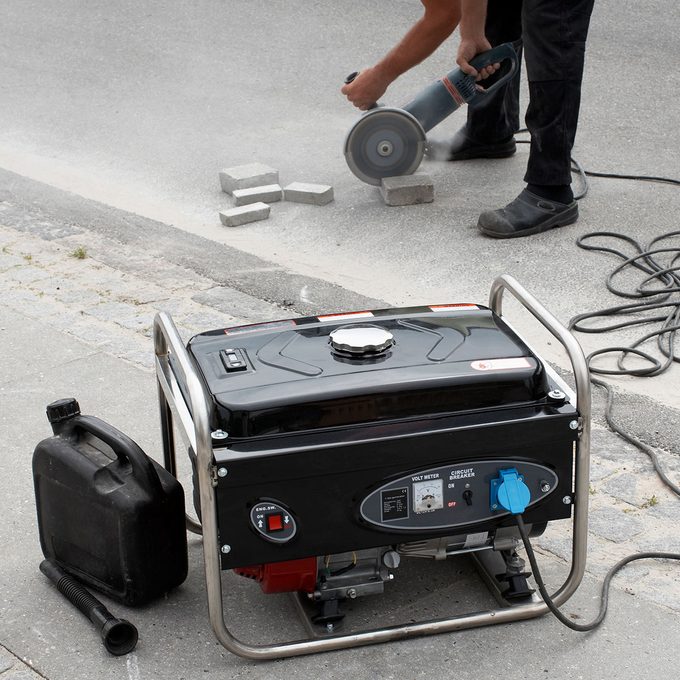
Power Generator Option i: Plug-in Generators
A Portable Generator
A portable backup generator with extension cords is the simplest and least expensive backup ability arrangement. Go on the generator at least 10 ft. from your house to avoid carbon monoxide poisoning.
A Twist-Lock Extension Cord
Apply a heavy-duty, twist-lock extension cord to plug into the inlet that'due south connected to your subpanel. The special ends continue the cord from pulling loose. Some generators come with a twist-lock string.
The most bones method of supplying backup power is running a portable generator in your yard, then plugging in extension cords that plug into your appliances. Information technology's also the to the lowest degree expensive solution since you don't need to hire an electrician to install a subpanel. The downside is you accept to run extension cords everywhere y'all want ability and y'all're express to how many things you lot can plug in at one time (most generators have either two or iv outlets). You also have to first and maintain the generator.
When the power goes out, place the generator on a flat surface outside, at least x ft. from the house. Don't set it under awnings, canopies or carports, or within the business firm or garage. It's admittedly disquisitional that y'all proceed the generator away from your house and especially abroad from doors and windows—your life could depend on it! More people die from carbon monoxide poisoning from the gas engines on generators than from the disasters causing the ability outages.
Caution:
Plug in a carbon monoxide detector when using a portable generator. It'll alert y'all if the generator frazzle reaches a dangerous level inside the house.
Extension cords must be at to the lowest degree 14 approximate to carry adequate ability. Follow the cord'southward maximum wattage rating (listed on the cord'due south characterization). Offset upwards the generator, then plug in the extension cords (photo above). Be conscientious non to overload the generator past plugging in high-wattage appliances that y'all didn't plan for. It'll trip the billow or accident a fuse on the generator, or impairment the appliance motors.
Portable backup generators range in price from $500 for a iii,250-watt unit of measurement to $ane,500 for a 10,000-watt unit. Options include wheels (become them—generators are very heavy to lift) and electrical (key) starts rather than pull-starts. Consider how long the generator can run on a tank of gas. Some run merely a few hours, and then you'll take to get up in the middle of the dark to add together fuel. Others have 16-gallon fuel tanks that can run up to 10 hours.
A Manual Transfer Switch Panel Makes Portable Ability More than Convenient
To use a portable generator without the hassle of running extension cords, hire an electrician to install a manual transfer switch subpanel off your main excursion panel and install a dedicated inlet to ability the subpanel (installing the subpanel is complex; not a DIY project). This setup gives you the advantage of powering unabridged circuits in the house, non just individual appliances. The drawback is y'all still accept to start and maintain the gas-powered generator. And unless you buy a big generator (they're available with more than 15,000 watts), you lot're still express in what yous can power.
Before calling an electrician to add the subpanel, choose what y'all want to power during an outage. Information technology'south worth including a circuit that'll let you lot run your TV, estimator and a lamp, especially if yous lose power for days at a time, so yous tin can proceed everyone entertained. Plus, these electronic devices don't require a lot of wattage. The circuits yous desire powered will be moved from your main circuit panel to your subpanel, so they'll run when you have normal power and when you lot lose electricity and claw up the generator. Expect to pay $200 for materials and at to the lowest degree $500 for an electrician to install the subpanel and special inlet.
During a ability outage, run a cord from the fill-in generator to the inlet, flip a manual transfer switch on the subpanel, and all the designated circuits volition have power. Choose a heavy-duty extension string (photograph above left) with twist-lock ends (generators have receptacles for these ends) that stay in place once they're plugged into the generator and inlet. Be sure to continue the generator at to the lowest degree 10 ft. from the house.
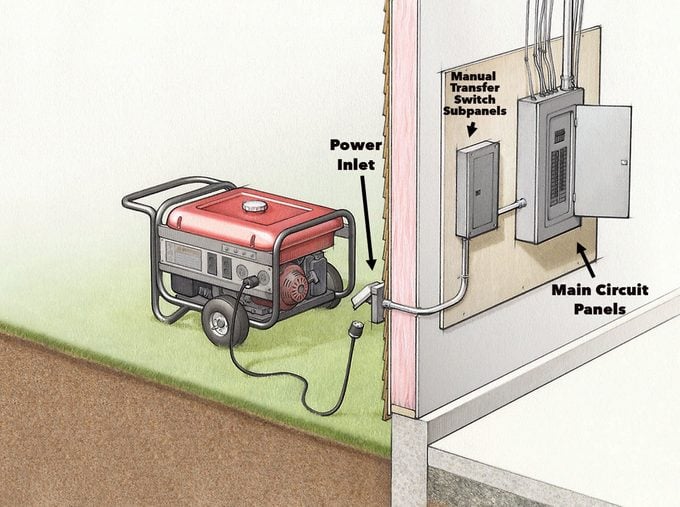
Don't Kill a Utility Worker
Don't attach a second male end to a power cord, then run it from the generator to a wall outlet to power a circuit (yes, people take done this). This may seem similar a clever way to run ability through your habitation's wiring system, but the electricity will run back through the excursion breaker panel and out to the utility lines, which can kill service personnel working on the lines, even if they're miles away.
Ability Generator Option two: Standby Generators
Standby generators automatically plough on when the power goes out—y'all don't take to exercise a affair. This is the all-time option if you oft lose electricity and want to continue all or most of your appliances running. Most standby generators are powerful enough to run a cardinal air conditioner, kitchen appliances, and other large items simultaneously. They're also quieter than portable generators and you don't need to worry virtually running cords or storing gasoline. The drawback is the toll. You'll need to take the generator, transfer switch, and subpanel professionally installed.
A transfer switch constantly monitors power. If you lose electricity, information technology starts the generator automatically—fifty-fifty if you're not home. When ability is restored, the transfer switch shuts off the generator.
Standby generators connect to your habitation'due south fuel supply (natural gas or propane). If you don't already accept one of these fuel lines coming into the house, install a propane tank.
Standby generators range from $5,000 for a vii,000-watt unit to more than than $15,000 for a xxx,000-watt unit (installation included). Domicile centers carry a limited option of portable generators (but ordinarily no standby units). Larger sizes and standby units are ordinarily bachelor through special order or from the manufacturer.
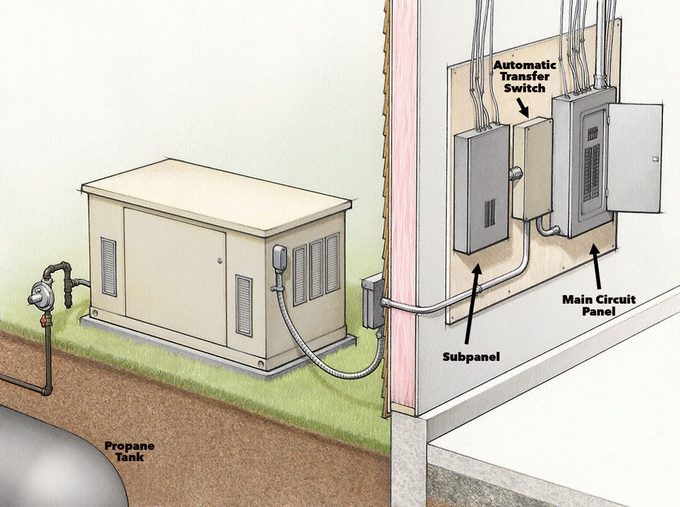
Standby Backup Generator Arrangement
Standby generators run off your home's natural gas supply or a propane tank, which can be underground. The transfer switch automatically starts the generator, which powers the circuits in the subpanel.
Source: https://www.familyhandyman.com/article/choosing-the-best-power-generator/
0 Response to "How to Choose the Best Generator for My House"
Post a Comment