Chapter 9: Inspect procedures
Affiliate learning objectives
When you have completed this chapter you will exist able to:
- Explain the assertions contained in the financial statements;
- Provide examples of procedures used to audit specific balances;
- Discuss and provide examples of how analytical procedures are used as noun procedures;
- Utilize audit techniques to modest and not-for-turn a profit organisations; and
- Hash out the bug associated with the inspect and review of bookkeeping estimates.
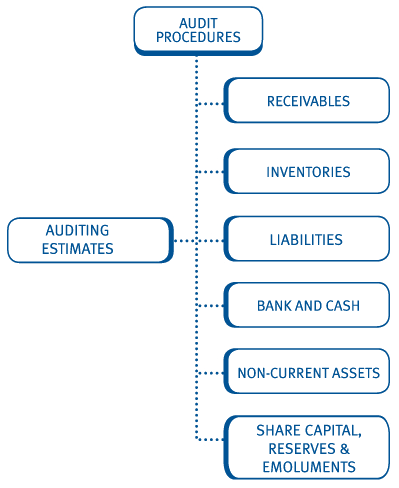
1 Full general principles
We dealt with the principles of inspect bear witness in an earlier chapter. This chapter deals with the awarding of those principles.
It is a starting point to help you familiarise yourself with the basic auditing techniques to allow y'all to use them to questions. It is not an exhaustive summary of all audit tests, this would simply not be possible in one volume.
2 Financial statements assertions
The objective of audit testing is to assist the accountant in coming to a decision as to whether the financial statements are free from material misstatement.
Yet, the auditor does not only pattern tests with the broad objective to identify cloth misstatement. This is a difficult determination to reach and tin just be based upon a series of detailed tests, each designed with a specific testing objective relating to certain areas of the financial statements.
For example: auditors have to assess whether inventory balances are free from textile misstatement. Unfortunately, at that place are many ways inventory could be misstated:
- items could be missed out of inventory;
- items from the adjacent accounting period could be accidentally included;
- it might non be valued at the lower of cost and net realisable value;
- damaged or obsolete stock might not exist identified;
- buy cost may not exist recorded accurately; or
- the stock count may not be performed thoroughly.
Each of these concerns could result in misstatement, which ultimately could (alone or in aggregate) be material.
For this reason auditors have to perform a range of tests on the meaning classes of transaction, account balances and disclosures to exist reasonably sure that they are not misstated. These tests focus on what are known equally financial statements assertions:
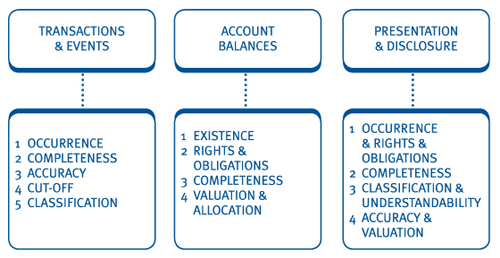
Occurrence â€" did the transactions and events recorded actual occur and pertain to the entity?
Completeness â€" accept all transactions, assets, liabilities and disinterestedness interests been recorded that should accept been recorded?
Accuracy â€" accept amounts, information and other information been recorded and disclosed appropriately?
Cut-off â€" have transactions and events been recorded in the correct accounting period?
Classification and understandability â€" have transactions and events been: recorded in the proper accounts; and described and disclosed clearly?
Existence â€" exercise assets, liabilities and disinterestedness interests exist?
Rights and obligations â€" does the entity concord or control the rights to assets and are liabilities the obligations of the entity?
Valuation and allocation â€" are assets, liabilities and equity interests included in the financial statements at appropriate values?

 Linking assertions to tests
When the accountant designs farther inspect procedures they must ensure that they examination a range of the assertions listed. For transactions (i.east. incomes and expenses recorded in the income statement) the auditor should test:
- occurrence;
- completeness;
- accuracy;
- cut-off; and
- classification
For accounts balances (i.due east. those balances recorded on the statement of financial position) the accountant should exam:
- existence;
- rights and obligations;
- abyss; and
- valuation and allotment.
Whilst the testing of accounts balances and transactions will probably be the focus of the audit, the auditor must likewise design tests to ensure that transactions, balances and other relevant information/matters are appropriately disclosed in the financial statements. Assertions relevant to the disclosures are:
- occurrence;
- rights and obligations;
- completeness;
- classification and understandability; and
- accuracy and valuation.
To assist your studies and simplify this process consider the post-obit four questions that an auditor needs to reply when approaching testing:
(ane)Should items be in the accounts at all? (occurrence, being, rights and obligations, cut-off).
(2)Are they included at the right value? (accuracy, valuation).
(3)Are there whatsoever more? (abyss).
(4)Are they disclosed properly? (classification, resource allotment, understandability).

A further alarm
In the sections that follow, nosotros will consider specific audit areas and advise how these are usually tested. You lot may be tempted to learn these tests and repeat them 'parrot way' in the exam. This would be unwise. Audit procedures are designed to reflect the unique risks of an audit and the nature of items and assertions under scrutiny. Yous must always try and make your answers specific to any scenarios presented in the exam. This requires both knowledge and application skills.
iii The audit of receivables
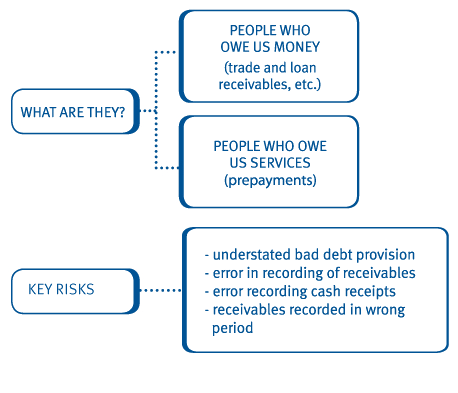
Key assertions
- Existence â€" the receivable actually exists;
- Rights and obligations â€" the visitor has rights to receive the benefit from receivables;
- Valuation and allocation â€" receivables are included in the fiscal statements at the correct amount, including provisions for bad and doubtful debt;
- Completeness â€" all receivables relating to the menstruation have been accounted for; and
- Nomenclature and understandability â€" receivables (including provisions) are appropriately disclosed in the financial statements.
Inspect procedures
Existence
- Perform a receivables circularisation ( a direct confirmation from external sources - see below).
- Select a sample of receivables and trace amounts due to the original sales invoice to confirm that a transaction has taken place;
Rights and obligations
- Receivables circularisation;
- Select a sample of receivables and confirm the trade terms to original credit agreements and sales invoices.
Valuation and allocation
- Inspect the ageing profile of receivables to identify any significant, long outstanding balances that may require a provision.
- Analytically review the ageing profile in comparison to previous periods to identify any deterioration in credit control.
- Inspect post year-end greenbacks book/bank statements and trace payments received to year-terminate receivables to ostend that amounts were indeed collectable.
- Discuss the results of the ageing and cash receipts analysis with management to identify if any further provisions are required for old, unpaid balances.
- Discuss the assumptions underlying any full general provisions with management to ensure they are appropriate.
- Recalculate the provision based on management’south assumptions and concur to the effigy in the fiscal statements.
- Audit invoices relating to prepaid balances, concur cost to calculations made.
- Inspect bank statements to ostend prepaid amounts accept been paid.
Completeness
- Obtain a listing of receivables balances, cast this and agree it to the receivables control account total at the cease of the year. Differences should exist reconciled.
- Perform a receivables circularisation.
- Inspect receivables ledger for credit balances and obtain explanations from management.
- Inspect a sample of the last 5 to ten goods despatched notes immediately prior to the yr-end. Trace these through to year-end receivables to ensure they accept been recorded.
Classification and understandability
- Inspect the draft financial statements and agree the receivables figures and disclosures to nominal ledger balances.
 Too annotation the outcome of directional testing, e.grand. direct testing receivables for overstatement besides indirectly tests revenue for understatement (Dr: Receivables, Cr: Revenue).
Receivables circularisations
If successful, circularisations provide evidence directly from the receivables themselves. These are considered to exist reliable because they are external, third party confirmations. Circularisations are also written and original.
Procedure
- Select a sample of receivables to be circularised and notify client of those selected;
- Extract details of each receivable from the relevant ledger and prepare messages. This should state the rest outstanding at the yr-stop and include a respond slip for receivables to confirm the residual;
- Inquire the chief accountant at the client (or other responsible official) to sign the letters;
- The auditor posts or faxes the letters to the individual receivables;
- Receivables complete the reply slips, confirming the amounts they owe the client at the year-terminate, and post them directly to the auditor; and
- The auditor investigates whatever disagreement by receivables.
Considerations
Whilst circularisations are undoubtedly a useful and efficient tool for providing skilful quality prove, their success does depend on response rates. It must be remembered that the audit customer'southward customers are under no obligation to answer and, for this reason, responses may be limited. If the response charge per unit is poor then other forms of testify must be sought. To maximise the response rate auditors should ensure:
- Letters are sent out every bit presently as possible after the year-end;
- That the outstanding balance is conspicuously displayed and all that receivables have to do is confirm whether this is correct or not;
- A respond slip is fastened to minimise the piece of work of the receivable; and
- Pre-paid return envelopes are supplied.
Example confirmation alphabetic character
Customer Ltd
Customer’south accost
Date of circularisation
Beloved Sirs
Equally function of their normal inspect procedures we have been requested by our auditors, Accountant & Co, to ask you lot to confirm the rest on your account with us at 31 December 2009, our year-stop.
The residue on your account, equally shown by our records, is shown below. After comparing this with your records will you delight be kind enough to sign the confirmation and return a copy to the auditor in the prepaid envelope enclosed. If the balance is not in understanding with your records, volition you please note the items making up the deviation in the space provided.
Please note that this asking is fabricated for audit purposes just and has no further significance.
Your kind co-operation in this thing will be greatly appreciated.
Yours faithfully

Accountant & Co
Auditor’southward address
Love Sirs
We confirm that, except as noted beneath×, a balance of $10,000 was attributable by us to Client Limited at 31 December 2009.
(space for customer's signature)
×Details of differences:
iv The audit of inventories

Key assertions
- Being â€" does the inventory recorded really exist?
- Completeness â€" accept all inventory balances been recorded?
- Rights and obligations â€" does the company have the rights to receive the benefits from inventories?
- Valuation and resource allotment â€" are inventories valued accordingly (i.e. at the lower of price and net realisable value and net of whatever provisions for damaged and slow moving appurtenances)?
- Cut-off â€" are inventory movements around the yr-cease recorded in the correct period?
- Classification and understandability â€" are inventories (including provisions) appropriately disclosed in the fiscal statements?
The inventory count
Principles
- A typical inventory count happens at the year-end, although continuous counting is possible throughout the year.
- The purpose of the count is to confirm that the quantities of inventory recorded on the customer's system are authentic.
- Whilst the count is being performed items that are damaged and/or obsolete should be identified for either scrapping or sale at a discounted price.
- From an inspect perspective, attendance at the count helps provide evidence regarding the beingness, completeness and valuation of inventory balances.
- Inventory counting is the responsibility of the client. The auditor merely attends the count to help gather evidence to course an opinion regarding whether inventory is free from textile misstatement or not.
Inventory counting procedures
Before the count
- Obtain the client's counting instructions and review them for obvious flaws in the counting process. This may also help identify if there are any pregnant or risky elements of inventory that require special attending, or even precautions.
During the count
- Discover the count as it proceeds to ensure:
- the counting instructions are existence followed
- all items are being counted and recorded
- there is no risk of double counting
- evidence of damaged or slow moving goods is being recorded
- deliveries and despatches are non being made during the count
- count recording sheets are being properly controlled (i.east. pre-numbered and filled in with ink).
- Comport test counts, on a suitable sample selection basis, as follows:
- select a sample of items from the inventory records and physically observe the items on the warehouse flooring to prove the items be.
- select a sample of physical items from the warehouse floor and trace them to the inventory records to ensure that the latter is complete.
- Record cut-off data past obtaining details of the terminal deliveries and despatches prior to the twelvemonth-end. These will then be traced to inventory records during terminal inspect procedures.
Continuous inventory systems
The procedures suggested higher up apply to all inventory counts, whether equally a i-off, year-stop exercise or where inventory is counted on a rolling basis throughout the year. The objective is the aforementioned:
- To place whether the client'southward inventory organisation reliably records, measures and reports inventory balances.
Where the client uses a continuous counting system lines of inventory are counted periodically (say monthly) throughout the twelvemonth so that by the end of the yr all lines accept been reviewed. There are both advantages and disadvantages of this for the auditor.
Advantages
- The auditor is less time constrained and tin can option and choose particular locations and inventory lines to count at whatsoever time to ensure the system is reliable.
- Boring moving and damaged inventory should be identified and adjusted for in the client's records on a continuous basis therefore, thus improving the valuation at the year-end.
Disadvantages
- The auditor volition need to gain sufficient testify that the system operates effectively at all times, not merely at the time of the count.
- Additional procedures will demand to exist devised to ensure that the year-cease inventory total is reliable, particularly with regard to cut-off and year-cease provisions/estimates.
Inventory held at third parties
- Where the client has inventory at locations not visited past the auditor, the accountant normally obtains confirmation of the quantities, value and status from the holder. The auditor needs to consider whether the holder is sufficiently independent to exist able to provide relevant, reliable evidence.
- As with confirmations from receivables, the auditor requests details from the party belongings the inventory on behalf of the client to confirm its existence.
- The confirmation request volition be sent past the client to those parties identified past the auditor.
- The answer should be sent directly to the auditor to forestall it being tampered with past the customer.
- Bug can occur if the third party uses a unlike description to that of the client and as ever, a response is not guaranteed.
Concluding audit procedures
Completeness
- Obtain an inventory list showing each line of inventory categorised between finished goods, WIP and raw materials. Cast the listing to ensure it is arithmetically correct. Make sure the totals agree to amounts disclosed in the financial statements.
- Trace the items counted during the inventory count to the final inventory list to ensure information technology is the aforementioned every bit the i used at the year-end and to ensure that any errors identified during counting procedures accept been rectified.
Cutting-off
- Trace the GRN'due south from immediately prior to the year-finish (identified during the count) to yr-end payables and inventory balances.
- Trace the GDN's from immediately prior to the yr-end (identified during the count) to the nominal ledgers to ensure the items were removed from inventory prior to the year-end and have been recorded in receivables prior to the year-end.
Presentation and disclosure
- Inspect the fiscal statements and ensure that the figures disclosed agree to the audited nominal ledger balances and that inventories accept been correctly analysed between finished goods, raw materials and work in progress.
Valuation
- Trace a sample of inventory items back to original purchase invoices to hold their cost.
- Trace a sample of inventory items to mail-year-end sales invoices to determine if the appropriate cost or net realisable value has been used.
- Inspect the ageing of inventory items to place any quondam/slow moving amounts that may require provision.
- Trace the higher up items to any inventory provisions and, if they have not been provided, discuss the reason with management.
- Recalculation of piece of work in progress and finished goods using payroll records for labour costs and utility bills for overhead assimilation.
- Summate inventory turnover/days and compare to last yr to appraise whether inventory is being held longer and therefore requires greater provisions.
- Calculate gross profit percentage and compare to prior year to identify any significant fluctuations that may signal either error or changes in inventory belongings policies.
5 The audit of payables, accruals, provisions and contingent liabilities
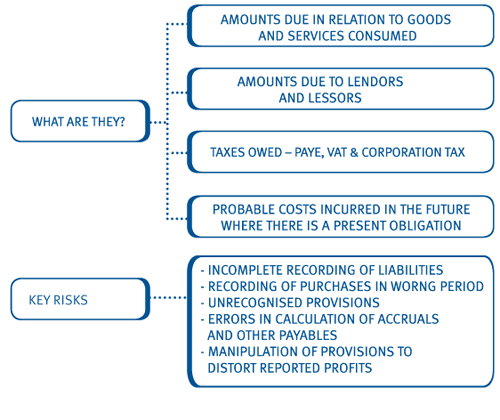
Key assertions
- Being â€" the payables really exist;
- Rights and obligations â€" the company has obligations to settle all payables;
- Valuation and resource allotment â€" payables are included in the fiscal statements at the correct amount;
- Abyss â€" all payables relating to the period have been deemed for.
- Classification and understandability â€" all payables are accordingly disclosed in the financial statements.
Completeness is usually the key consideration when testing payables due to the timing and nature of the items included. Provisions and accruals bookkeeping practise offer an opportunity for creative accounting to manipulate reported profits. Auditors therefore have to consider indicators that boosted liabilities may be, such every bit:
- payables not including known major suppliers and those accrued for in the prior year;
- payables not including the significant suppliers from the equivalent listing last year;
- traditionally recurring accruals not existence made, due east.g.: rent, utilities, telephone, etc.
- expected finance accruals not beingness made, e.g.: hire purchase, mortgages, loans etc.
- non-provision of tax balances, including: corporation revenue enhancement, payroll taxes, sales taxes, etc.
- suppliers revealed merely afterwards a review of payments afterward the year-cease; and
- suppliers revealed past a review of unpaid invoices at and after the twelvemonth-end.
Classification and understandability
- Inspect fiscal statements to ensure that all liabilities from the nominal ledger have been fairly and accurately disclosed.
Being
- Circularise a sample of merchandise payables to confirm the remainder at the finish of the yr (this is uncommon and would simply be performed in the absence of supplier statements).
- Inspect twelvemonth-end statements of accounts sent by suppliers. Any differences between the statement and the nominal ledger should be reconciled.
- Trace a sample of payable/accruals balances to purchase invoices and/or contracts. In detail identify the date of receipt of the invoice and whatsoever evidence of payment (such as signatures).
Completeness
- Bandage the payables ledger to ensure its accurateness.
- Inspect yr-end statements of accounts sent by suppliers. Whatever differences between the statement and the nominal ledger should be reconciled.
- Investigate whatsoever major (past value of purchases in the year) or known regular suppliers that were shown on terminal year's payables list but do not have a remainder showing in this year's list of balances.
- Enquire of management why the above suppliers exercise not characteristic in this year's payables list.
- Inspect after date payments in the cash book and bank statements and ensure they have been provided for at the year-end, as appropriate.
- Perform analytical procedures on the listing of payables, such as: payables days, payables as a percentage of purchases, monthly payables levels. Investigate whatever unusual variances.
- Compare the purchase ledger control account to the list of payables. Reconcile any variations.
- Inspect the list of balances for debit balances. Discuss results with management.
Cutting-off
- Select a sample of GRN's raised immediately prior to the twelvemonth-end and trace them through to year-terminate payables.
- Besides, select a sample of GRN's raised immediately later on the year-end and trace them to the nominal ledger to ensure they have been recorded in the side by side accounting menstruation.
Once more, note the effect of directional testing, east.grand. directly testing payables for understatement likewise indirectly tests expenses/price of sales for understatement (Dr: Expenses/Cost of sales, Cr: Payables).
Supplier statements
Companies may transport out monthly statements of account equally part of their credit control procedures. Therefore it is likely that inspect clients will receive a number of these statements from suppliers at the yr-terminate. These can be reconciled to their own payables control business relationship to ensure that their records are right. This is known as a supplier statement reconciliation and is an important source of audit testify. Like almost statements sent through the mail service there are a number of reasons why there may be variances:
(1)Timing differences:
- Invoices sent by the supplier but non yet received by the client.
- Payments sent by the client but non yet received by the supplier.
- Returns and credit notes not yet appearing on the supplier’south statement.
(2)Errors
- Supplier errors that will remain equally role of the reconciliation until the supplier corrects them.
- Client errors, which the customer needs to adjust.
Auditors can inspect or reperform the supplier statement reconciliations to ensure the abyss, existence and valuation of payable balances. They are a reliable source of bear witness considering they are produced by the suppliers, who are (commonly) independent, external sources (but annotation suppliers may be related parties/intergroup companies, and therefore not independent).
Accruals
- Inspect invoices received after the year-end that relate to services provided earlier the year-cease. Trace them to any accruals fabricated to ensure completeness and accurateness of the amounts.
- Obtain the list of accruals from the customer, cast information technology to confirm arithmetical accuracy.
- Hold the figure per the schedule to the general/nominal ledger and financial statements
- Recalculate a sample of accrued costs past reference to contracts and payment schedules (e.g. loan interest).
- Analytically review in comparison to previous period to try and identify if whatsoever balances are perhaps missing.
Taxation balances
- Corporation/Profits taxes â€" concord to taxation computations.
- Payroll taxes â€" hold to payroll records.
Overdrafts, loans, etc.
- Agree to bank letter of the alphabet confirmation of outstanding amounts.
Leases, hire purchase
- Agree details to underlying understanding/contracts and recalculate interest amounts and the separate between current and non-current.
Loan payables
- Concur the twelvemonth-terminate loan balance to any available loan statements to ostend obligations, existence and valuation.
- Hold interest payments to the loan agreement and the banking company statements.
- Analyse relevant disclosures of interest rates, amounts due (eastward.thou. between current and non-current payables) to ensure complete and accurate.
- Recalculate the involvement accrual to ensure arithmetical accurateness.
Provisions and contingencies
Provisions are a form of payable where the amount or timing of payment is uncertain. As such they are harder to inspect.
Where the likelihood of payment is only possible, rather than probable, no amounts will exist entered in the accounts. However, the matter (contingent liability) must be adequately disclosed.
- Discuss the matter giving rise to the provision with the client to verify whether an obligation exists.
- Obtain confirmation from the clients lawyers as to the possible effect and probability of having to make a payment.
- Review subsequent events. Past the time the final audit is taking identify the matter may take been settled.
- Obtain a letter of representation from the client as the matter is one of judgement and uncertainty (see 'Completion' chapter for further word).
- Recalculate the provision if possible, eastward.yard. warranty provisions for repairs.
6 The audit of bank and cash
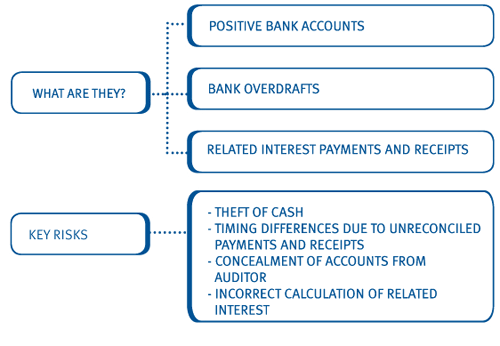
Primal assertions
- Existence â€" greenbacks and depository financial institution balances actually exist;
- Rights and obligations â€" the company has rights to receive the do good from those balances;
- Valuation and allocation â€" balances are included in the fiscal statements at the right corporeality;
- Completeness â€" all balances have been accounted for.
- Classification and understandability â€" balances are appropriately disclosed in the financial statements?
The bank letter
- This is a directly confirmation of bank balances from the banking concern that gives the accountant independent, tertiary-party show.
- The format of the letter is usually standard and agreed between the banking and auditing professions.
- Issues covered are:
- the client’s proper name
- the confirmation date
- balances on all depository financial institution accounts held
- whatsoever documents or other assets held for safekeeping
- details of any security given
- details of any contingent arrangements â€" guarantees, frontwards currency purchases or sales, letters of credit.
- The auditor needs the client to give the bank authorisation to disclose the necessary information (in some jurisdictions such disclosures are illegal so bank letters cannot be used at all).
- Ensure that all banks that the client deals with are circularised.
- The balances for each business relationship should be agreed to the relevant depository financial institution reconciliation at the year end;
- Details of loans should be agreed to the disclosure in the argument of financial position as either current or non-current.
Example depository financial institution confirmation letter
Whites & Harper Inc.
14 The Grove
Kingston
KI4 6AP
Manager (Audit Confirmations)
National Banking company Anytown Co-operative
Loftier Street, Anytown
AT1 1HS
1 Jan 20X1
Dear Sir,
Re: Blakes Co.
In accordance with the agreed exercise for provision of information to auditors, please forward information on our mutual client every bit detailed below on behalf of the banking concern, its branches and subsidiaries. This request and your response will not create whatever contractual or other duty with united states of america.
Visitor name: Blakes Co.
Main business relationship number: 01789311
Sort code: 4-83-12
Information required

- Derivative and commodity trading
- Custodian arrangements
- Other information (come across attached)
Audit confirmation date: 31/12/X0
The Authority to Disclose Data signed by your customer is already held by you. This is dated 30/08/X0. Please suggest usa if this Authority is bereft for you lot to provide full disclosure of the information requested.
The contact name is: James Hodges (Inspect Partner)
Telephone: 01234 123456
Yours Faithfully,

Whites & Harper Inc.
Depository financial institution and cash â€" other evidence
- Obtain a list of all banking concern accounts, cash balances and bank loans and overdrafts and concur to totals to figures included in current assets and current liabilities in the financial statements.
- Obtain a copy of the client's bank reconciliation, cast and agree the balances to the cash book and bank letter.
Example banking concern reconciliation
Banking concern reconciliation every bit at 31 December 20X0

- Trace all outstanding lodgements and unpresented cheques to pre-year-end cash book and post-twelvemonth-end depository financial institution statements.
- Ensure all accounts in the bank letter are included in the fiscal statements.
- Ensure bank loans and overdrafts are not showtime confronting positive banking concern balances in the financial statements.
- Count the little greenbacks in the cash tin at the end of the year and concord the total to the rest included in the financial statements.
Presentation and disclosure
- Inspect the draft fiscal statements and ensure that amounts are disclosed correctly every bit either assets (positive balances) or liabilities (overdrafts) and that the amounts recorded agree to the nominal ledger.
7 The audit of tangible non-current avails

Key assertions
- Existence â€" assets actually exist;
- Rights and obligations â€" the company has rights to receive the benefit from those assets;
- Valuation and allocation â€" assets are included in the financial statements at the right corporeality;
- Abyss â€" all assets have been accounted for.
- Classification and understandability â€" avails are appropriately disclosed in the financial statements?
Being
- Select a sample of assets from the non-current asset register and physically inspect them.
Completeness
- Select a sample of assets visible at the client bounds and inspect the asset register to ensure they are included.
- Examine the repairs and maintenance accounts in the general ledger for large and unusual items that may be capital in nature. These should exist included in the statement of financial position, not expenses.
Valuation
- Cast the non-current asset register to ensure arithmetical accuracy.
- Recalculate the depreciation charge for a sample of assets.
- Analytically review depreciation charges in comparison to the prior year.
- Perform a proof in total by adjusting the prior year figure for all additions, disposals and revaluations so calculating total depreciation based upon this effigy.
- Compare depreciation methods and policies in comparison to the previous twelvemonth to ensure consistency.
- If whatever avails have been revalued during the yr:
- agree new valuation to valuer’s report
- verify that all avails in the aforementioned class have been revalued
- reperform depreciation calculation to verify that charge is based on new conveying value.
- When physically inspecting avails, take note of their condition and usage in case of damage.
- For a sample of asset additions, agree the cost to buy invoices (or other relevant documentation).
- If any avails have been constructed by the company, obtain analysis of costs incurred and agree to supporting documentation (timesheets, materials invoices, etc.).
Rights and obligations
- For a sample of recorded avails, obtain and inspect ownership documentation:
- title deeds for properties
- registration documents for vehicles
- insurance documents may as well help to verify ownership (and asset values).
- Where assets are leased, inspect the charter certificate to assess whether the charter is operating or finance (if the latter, the asset should be included on the company’s statement of financial position).
Disclosure
- Agree opening balances with prior year financial statements.
- Compare depreciation rates in use with those disclosed.
- For revalued avails, ensure appropriate disclosures made (east.g. name of valuer, revaluation policy).
- Hold breakdown of assets between classes with the general ledger account totals.
viii The audit of share capital, reserves and directors' remuneration
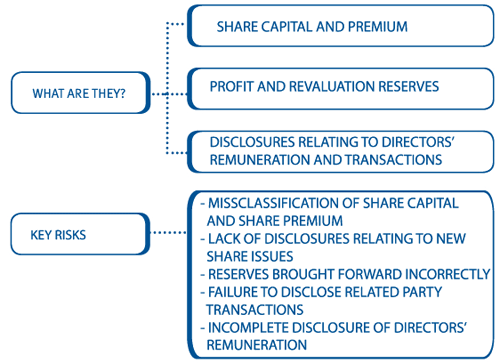
 Directors' remuneration is a fundamental audit area as it is invariably material past nature.
Cardinal assertions
- Being â€" practise share upper-case letter balances and reserves really exist;
- Rights and obligations â€" the company has obligations regarding disinterestedness balances;
- Valuation and allocation â€" equity is included in the financial statements at the right amount;
- Completeness â€" all equity balances, directors' remuneration and other transactions with directors have been accounted for.
- Classification and understandability â€" relevant disclosures have been made in the financial statements, particularly with regard to directors' remuneration.
Share capital
- Agree authorised share capital and nominal value disclosures to underlying shareholding agreements, such as company memorandums, articles of clan and lists of registered members;
- Audit cash book for evidence of cash receipts from share issues;
- Inspect terms of share certificates and reconcile to cash receipts and new share capital totals;
- Inspect board minutes to place if any dividends take been declared prior to the yr-finish;
Directors' remuneration
- Reconcile reported directors' salaries to payroll records;
- Audit board minutes for evidence of directors' bonus announcements;
- Reconcile directors' bonuses to greenbacks payments in the greenbacks book;
- Inspect board minutes for approval of related party transactions;
- Obtain a written representation from directors that they have disclosed all related party transactions and director remunerations to the auditor.
Reserves
- Reconcile closing turn a profit reserves to: opening reserves, profit for the yr and dividend paid and proposed during the twelvemonth;
- Compare opening reserves to closing reserves reported in the prior year's fiscal statements;
- Reconcile movements in revaluation reserves to the non-current asset register;
- Corroborate revaluations past comparison to independently produced reports.
nine Accounting estimates
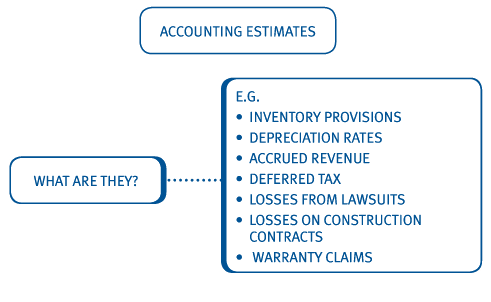
Accounting estimates are of particular concern to the auditor as, by their nature, at that place may not exist whatever physical evidence to back up them and they are decumbent to inaccuracy. They are also subjective and therefore prone to direction bias. If the directors wished to dispense the accounts in whatever way, accounting estimates are an piece of cake way for them to do this. The auditor must take intendance when auditing estimates to ensure this has non been the case.
In accordance with ISA 540 Auditing Accounting Estimates auditors demand to obtain an understanding of:
- How direction identifies those transactions, events and conditions that give ascent to the need for estimates; and
- How management actually makes the estimates, including the control procedures in place to minimise the risk of misstatement.
ISA 540 too requires the accountant to:
- Evaluate the degree of dubiousness associated with an accounting estimate; and
- Consider if estimates with a high degree of uncertainty give rise to significant risks.
In response to this assessment auditors should perform the following farther procedures:
- Review of the outcome of the estimates made in the prior catamenia (or their subsequent reestimation);
- Consider events afterwards the reporting engagement that provide additional prove about estimates made at the twelvemonth-end;
- Test the basis and information upon which management made the approximate (e.g. review mathematical methods);
- Test the operating effectiveness of controls over how estimates are fabricated;
- Develop an independent estimate to use as a point of comparison; and
- Consider whether specialist skills/noesis are required (e.g. lawyer).
Smaller entities

Smaller commercial entities volition commonly have the higher up attributes. This can atomic number 82 to both advantages and disadvantages:
- Lower risk: Smaller entities may well be engaged in activeness that is relatively simple and therefore lower take a chance. However, this will not be truthful for pocket-sized â€" often ane person businesses â€" where there is a high level of expertise in a particular field, e.m. consultancy businesses, creative businesses, the fiscal sector.
- Direct control by owner managers is a strength because they know what is going on and accept the ability to do real control. They are also in a strong position to dispense the figures or put private transactions ‘through the books’.
- Simpler systems: Smaller entities are less likely to have sophisticated It systems, merely pure, transmission systems are condign increasingly rare. This is practiced news in that many of the bookkeeping errors associated with smaller entities may at present be less prevalent. Nevertheless, a system is only as good as the person operating it.
Bear witness implications
- The normal rules concerning the human relationship betwixt risk and the quality and quantity of evidence apply irrespective of the size of the entity.
- The quantity of evidence may well be less than for a larger organisation.
- It may be more efficient to deport out 100% testing in a smaller arrangement.
Problems
- Management override â€" Smaller entities volition have a key director or manager who will have significant power and dominance. This could mean that controls are defective in the commencement place or they are easy to override.
- No segregation of duties â€" Smaller entities tend to have few accounts clerks that processes information. To overcome this the directors should authorise and review the all work performed.
- Less formal approach â€" Smaller entities tend to take simple systems and very few controls due to the trust and the lack of complexity. It is therefore hard to test the reliability of systems and noun testing tends to be used more than.
Non-for-profit organisations
Not for profit (NFP) organisations include charities and public sector entities. The nigh important differences from privately owned companies are that NFP entities:
- do not have profit maximisation as their main objective. These will be either social or philanthropic;
- do not have external shareholders; and
- will not distribute dividends.
Potential problems auditing a NFP entity
Some NFP entities, specially pocket-size charities, may accept weaker systems due to:
- lack of segregation of duties, as the organisation will be restricted with the corporeality of staff;
- the utilise of volunteers, who are probable to be unqualified and have little awareness of the importance of controls;
- the utilize of less formalised systems and controls.
Significantly, with many charities, much of the income received is by way of donation. These transactions will not be accompanied past invoices, orders or despatch notes.
Assessing the going concern of a NFP entity may also be more difficult, particularly for charities who are reliant on voluntary donations. Many issues, such as the state of the economy, could impact on their ability to generate acquirement in the brusque term.
Audit implications
Auditors of not for turn a profit organisations will be required to assess whether the aims of the organization are being met in an economical, efficient and effective manner. For this reason "value for coin" audits are much more appropriate. These are discussed in more detail in the internal inspect chapter.
Testing tends to concentrate on substantive procedures where control systems are defective. In the absenteeism of documentary evidence procedures rely heavily on analytical review, research and management representation.
The volumes of transactions in not for profit organisations may exist lower than a private one, therefore auditors may exist able to exam a larger % of transactions.
Ultimately, if sufficient appropriate testify is not bachelor the accountant will have to modify their inspect report.
 Test your understanding 1
List and explain 4 assertions from ISA 315 Identifying and Assessing the Hazard of Material Misstatement Through Understanding the Entity and its Environs that relate to the recording of classes of transactions.
| Real examination question: June 2009 | (4 marks) |
Exam your understanding 2
Listing Iv assertions relevant to the inspect of tangible non-current assets and land one audit procedure which provides appropriate evidence for each exclamation.
| Real test question: Dec 2008 | (4 marks) |
Test your agreement 3
(a)Ascertain 'tests of control' and explain why they are an of import procedure in the statutory audit of any visitor.
(4 marks)
You are an inspect senior working at a medium sized firm of auditors. One of your clients is an sectional hotel called ‘Numero Uno’ situated in the eye of Big City. As part of your audit procedures y'all are assessing the controls surrounding payroll. Y'all take read last year’s audit file and have obtained the following information:
The hotel employs both full and function time staff. Due to the nature of the business virtually of the work is done in shifts. All staff are paid on a monthly basis.
New members of staff are given an electronic photograph identification card on the mean solar day they bring together by the personnel department. This carte du jour is used to ‘clock in’ and ‘clock out’ at the first and end of the shift to record the hours worked.
At the end of each week the information recorded on the system is sent automatically to the payroll department and also to the caput of each of the 3 master operating divisions: Rooms, Nutrient & Beverage and Corporate Events. Each division head must reply back to the payroll department by email to authorise the hours worked by their staff.
The payroll clerk collates all the authorised data and then inputs the hours worked into a standardised computerised payroll package. This system is countersign protected using an alphanumerical password that only the payroll clerk and the finance manager know.
One time the hours have been inputted, the calculations of gross pay and revenue enhancement are calculated automatically forth with whatsoever other statutory deductions. At the cease of the calculations a payroll report is produced and printed. The finance manager reviews the study and compares the data to last calendar month to identify and follow up any unusual variances. When he is satisfied with the information he authorises the payroll run by signing the payroll report and the payroll clerk submits the information.
Payslips are sent to the home accost of each employee and payment is fabricated by depository financial institution transfer.
‘Numero Uno’ prides itself on delivering a first class dining experience and is renowned for its standards of service and cooking that few restaurants in the country come shut to. Its inventory therefore consists of the very best foods and beverages from across the globe.
Nutrient products held in inventory are by and large fresh as the caput chef will just work with the very all-time ingredients. ‘Food’ inventory is stored in the kitchens and managed by the caput chef himself.
The majority of beverages held at the hotel are expensive wines that accept been sourced from exclusive vineyards. The hotel also stocks a wide range of spirits and mixers. All beverages are stored either in the hotel cellar or backside the bar. The cellar tin just exist accessed by the duty managing director who holds the key. As part of your inspect procedures you will attend the year end inventory count of the hotel’s beverages.
Required:
(b)With reference to the scenario:
(i) Place and explain 4 STRENGTHS within the hotel’s internal control arrangement in respect of payroll.
(6 marks)
(ii) For each of the identified strengths, state a test of command the auditor could perform to appraise if the controls are operating effectively.
(4 marks)
(c)Depict the audit procedures an accountant would deport before and whilst attending the inventory count of the beverages in the hotel.
(8 marks)
(d)Place and explain THREE financial statement assertions that are most relevant to inventory.
(three marks)
(due east)Autonomously from attention the inventory count, describe the substantive procedures an auditor would carry out to confirm the valuation of the wine and spirits held in inventory at the year end.
(five marks)
(Total: 30 marks)
Examination your understanding 4
(a)Depict the steps an auditor should take when conducting a trade receivables confirmation (circularisation) test.
(4 marks)
(b)Explain why a direct confirmation test may not provide sufficient advisable audit evidence on its own.
(3 marks)
You are the audit managing director in charge of the audit of Builders Mate, a limited liability company. The company’southward year end is 31 March, and Builders Mate has been an audit client for three years. Builders Mate sells small tools, plant and equipment exclusively to the building trade. They take 12 warehouse style shops located throughout the country. Builders Mate does not manufacture whatever products themselves.
The audit fieldwork is due to commence in three weeks time and you are preparing the audit work programme for the trade receivables department of the inspect. Extracts from the clients trial residue bear witness the post-obit information.

From your review of terminal year’s inspect file you take determined that last year there were 2 specific provisions of $5k and $2k also as a iii% general provision.
Initial conversations with the customer indicate that there are no specific provisions that are to be made this twelvemonth however they intend to reduce the general provision from 3% to ii%.
You are aware that two of Builders Mate’s major customers went into administration during the year and they are likely to exist liquidated in the near futurity. Both of these customers owed material amounts at the yr-cease.
Required:
(c)Depict noun procedures the auditor should perform on the year-end trade receivables of Builders Mate.
(ix marks)
(d)Describe how audit software could facilitate the audit of trade receivables.
(Total: xx marks)
ten Affiliate summary
Test your understanding answers
Exam your understanding 1
Assertions: classes of transactions
- Occurrence: The transactions and events that have been recorded have really occurred and pertain to the entity.
- Completeness: All transactions and events that should have been recorded have been recorded.
- Accuracy: The amounts and other data relating to recorded transactions and events take been recorded appropriately.
- Cut-off: Transactions and events have been recorded in the correct bookkeeping menstruation.
Classification. Transactions and events have been recorded in the proper accounts.
Test your understanding 2
Tangible non-current avails: assertions
- Completeness: ensure that all non-electric current assets are recorded in the non-current asset register by agreeing a sample of assets physically verified back to the annals.
- Existence: ensure non-current assets be by taking a sample of assets from the annals and physically seeing the asset.
- Valuation and allocation: ensure assets are correctly valued by checking the reasonableness of depreciation calculations.
- Rights and obligations: ensure the company owns the asset past seeing appropriate document of ownership for instance, a purchase invoice.
- Presentation and disclosure assertions: ensure all necessary fiscal statements disclosures accept been fabricated by reviewing the fiscal statements.
Note: Only 4 assertions were required.
Test your understanding iii
(a)Tests of control
A test of command tests the operating effectiveness of controls in preventing, detecting or correcting textile misstatements.
It is important for the external auditor to test controls to ensure their initial understanding obtained when assessing the control environment and internal controls is appropriate.
This will allow the auditor to identify and assess the risks of fabric misstatements in the financial statements and to determine to what extent to rely on the internal command system during the audit.
The auditor will then be able to design sufficient and appropriate noun audit procedures to reduce detection risk, and therefore audit take chances, to an acceptable level.
(b)Payroll organization strengths and tests of command
Strengths in the control environment at the hotel in respect of payroll are fix out below including the test of control to be performed by the auditor.
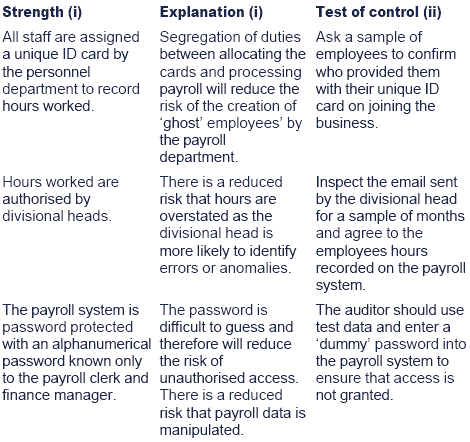
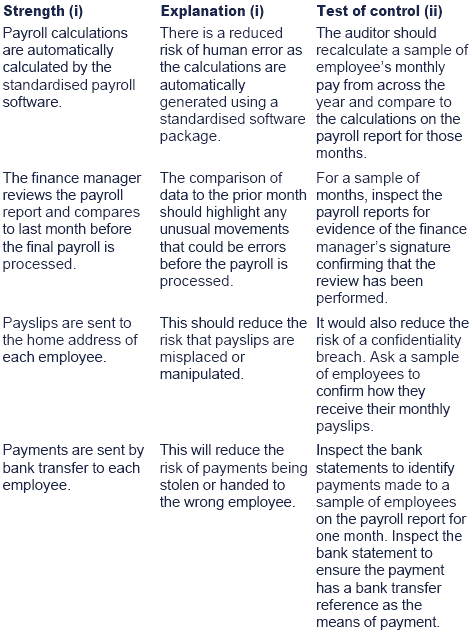
(c)Procedures before the count
- Review prior twelvemonth working papers to understand the inventory count process and identify any issues that would need to be taken into business relationship this twelvemonth.
- Contact Numero Uno (client) to obtain stocktaking instructions for this twelvemonth to understand how the count volition be conducted and assess the effectiveness of the count process.
- Book audit staff to attend the inventory count.
- Ascertain whether any inventory is held by third parties and if applicable decide how to gather sufficient audit evidence.
- Consider the demand for using an skilful to assist in valuing the inventory being counted. At that place may be some speciality wines and spirits that require expert valuation.
During the count
- Detect the count to ensure that the instructions are existence followed.
- Inspect the bottles being counted for evidence of damage or obsolescence that may touch on the net realisable value and hence overall valuation of inventory.
- Perform a exam count. Select a sample of beverages from the inventory count sheets and physically observe the items in the cellar or bar to confirm they exist.
- Perform a test count. Select a sample of physical beverages from the cellar or bar and trace to the inventory count sheets to ensure that they are recorded accurately and therefore that the records are complete.
- Tape cut off information past obtaining details of the final deliveries prior to the twelvemonth finish. This data will be used in final inspect procedures to ensure that no further amendments have been made thereby overstating or understating inventory.
(d)Inventory assertions
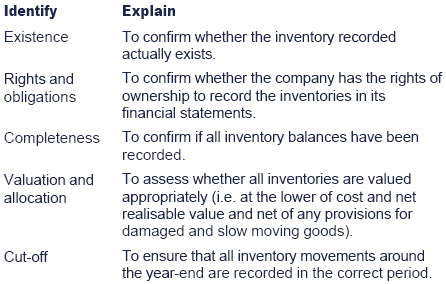
(due east)Substantive procedures
Quantity
- For the inspect exam counts performed during the inventory count trace and agree the quantities to the final inventory records to ensure the integrity of the information.
The beverages should be valued at the lower of cost and internet realisable value.
- For a sample of beverages on the inventory records, trace the toll of those items to the original purchase invoice, ensuring that the description of appurtenances on the invoice matches the beverage.
- For beverages sold to customers after the year end, check a sample of restaurant bills/invoices dorsum to the final inventory records ensuring that the sales value exceeds the cost. Where sales value is less than toll, ensure that the beverage is stated at the realisable value.
- For high value items such as Champagne, vintage wine and exotic spirits employ an expert valuer to review the net realisable value of a sample of items to ensure the value is reasonable.
- Inventory noted during the count equally possibly obsolete or damaged should be traced to the inventory records to ensure the valuation has been adjusted to take this into account. The expert valuer may provide assistance with these valuations.
Test your understanding 4
(a)Trade receivables circularisation
Several steps should be performed by an accountant when performing a trade receivables circularisation audit exam:
- Audit customer approval should be obtained in accelerate to perform the straight confirmation test of merchandise receivables.
- The population for the sample should be determined and a suitable sample selected using an advisable sampling technique.
- The confirmation alphabetic character should be designed and prepared for each receivable ensuring the contact details are correct and return details clearly state that the reply should be fabricated direct to the auditor.
- A business organisation reply envelope, addressed to the accountant, could be included for this purpose.
- The sending of letters, including any follow-upward requests, should be controlled and performed past the auditor to ensure the integrity of the exam.
- Replies should exist matched or reconciled to the audit client’southward receivables accounting records.
- Alternative audit procedures volition be required for all not-responses to the confirmation alphabetic character.
(b)Sufficiency of the bear witness from a direct confirmation test.
Several factors influence the sufficiency of evidence gathered during a direct confirmation of trade receivables and other evidence may be required by an auditor to form an opinion in this area:
- There is oft a low response charge per unit from trade receivables pregnant that other audit procedures will be required for these balances.
- The type of confirmation alphabetic character, whether a positive or negative confirmation request, will influence the sufficiency of evidence gathered. Negative confirmations provide less persuasive inspect evidence than positive confirmations and it is unlikely that a negative confirmation will provide sufficient evidence on its own.
- The reliability of the responses to the confirmation requests may exist in doubt for case if there is a risk of fraud existence perpetrated.
- Mistakes and errors may be present in the accounting records of the trade receivables confirming the rest outstanding.
(c)Substantive procedures for trade receivables.
- Trace and concord the receivables balances on the trial rest to Builders Mate’southward accounting system and the draft financial statements.
- Ostend the trade receivables control account balance matches the sum of the individual trade receivables ledger accounts.
- For a sample goods dispatched notes around the year-cease trace to the sales invoice and ledger accounts to ensure that the transactions accept been recorded in the correct accounting menstruum.
- Cast a sample of trade receivable ledger accounts to ostend arithmetical accuracy.
- Select a sample of individual merchandise receivables and perform a direct confirmation test using a positive confirmation letter.
- For non-responses to the direct confirmation test confirm cash has been received postal service year-end for the outstanding amounts.
- Greenbacks receipts recorded in the merchandise receivables ledger account should be traced and agreed to their remittance advice also as the cash book and bank statements.
- Recalculate the general provision based on the two% effigy to ensure arithmetical accuracy.
- Discuss with the Builders Mate management why the full general provision has reduced from 3% to two% and assess the reasonableness of the explanations provided.
- Obtain or prepare an aged receivables analysis to identify anile debts that may require a specific provision. Discuss with direction any such balances and ensure specific provisions are made if appropriate.
- Trace and ostend that the specific provisions made in the prior year were either written off or the greenbacks was recovered in the current accounting period.
- Discuss with management the reason for not making specific provisions for the 2 customers in administration who owe cloth amounts at the year-terminate.
- Consider and talk over with management the potential implications of declining to make specific provisions on the inspect stance.
- Compare a sample of individual trade receivables to their prior yr balance and investigate whatever unusual or unexpected changes betwixt the balances.
(d)Audit software
Audit software tin be used to improve the effectiveness and efficiency of the audit process of merchandise receivables.
- Audit software can be used to gear up an aged receivables assay and to place potential irrecoverable debts using a range of criteria set past the auditor.
- Information technology can analyse the receivables ledger for credit balances or negative balances.
- Audit software will be more efficient and accurate at casting and recalculating figures, totals and balances such as the general provision or casting of the receivables ledgers.
- It could also select a sample for testing and gear up straight confirmation letters.

| Created at 5/24/2012 ii:38 PM by System Business relationship (GMT) Greenwich Mean Fourth dimension : Dublin, Edinburgh, Lisbon, London |
Terminal modified at x/four/2012 8:36 AM by Organisation Business relationship (GMT) Greenwich Hateful Fourth dimension : Dublin, Edinburgh, Lisbon, London
| |
| |
| |
Rating : |  Ratings & Comments (Click the stars to rate the page) Ratings & Comments (Click the stars to rate the page) |
| |
Tags: | |
0 Response to "if property is audited at an interim date, what procedures will need to be done at year-end?"
Post a Comment