Which New Deal Agency Was Created to Help the American People Trust Banks Again
"The emergency banking legislation passed by the Congress today is a most effective step toward the solution of the financial and cyberbanking difficulties which take confronted the land. The extraordinary rapidity with which this legislation was enacted by the Congress heartens and encourages the land."
—Secretary of the Treasury William Woodin, March 9, 1933
"I can assure you that it is safer to go on your coin in a reopened bank than nether the mattress."
—President Franklin Roosevelt in his first Fireside Chat, March 12, 1933
Immediately subsequently his inauguration in March 1933, President Franklin Roosevelt set out to rebuild conviction in the nation'southward cyberbanking organization. At the time, the Great Depression was crippling the U.s. economic system. Many people were withdrawing their coin from banks and keeping information technology at home. In response, the new president called a special session of Congress the solar day after the inauguration and declared a four-day banking vacation that shut down the banking system, including the Federal Reserve. This action was followed a few days after by the passage of the Emergency Banking Act, which was intended to restore Americans' confidence in banks when they reopened.
The legislation, which provided for the reopening of the banks as soon as examiners found them to be financially secure, was prepared by Treasury staff during Herbert Hoover'southward administration and was introduced on March 9, 1933. It passed later on that evening amid a chaotic scene on the floor of Congress. In fact, many in Congress did not even have an opportunity to read the legislation before a vote was called for.
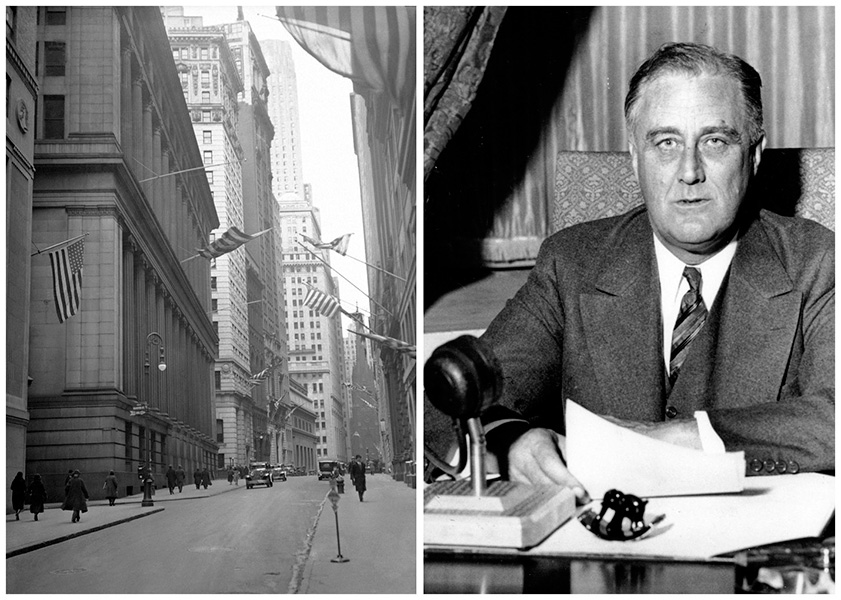
In his first Fireside Chat on March 12, 1933, Roosevelt explained the Emergency Banking Act equally legislation that was "promptly and patriotically passed past the Congress ... [that] gave authority to develop a program of rehabilitation of our banking facilities. ... The new law allows the twelve Federal Reserve Banks to upshot additional currency on expert avails and thus the banks that reopen will be able to come across every legitimate call. The new currency is being sent out by the Bureau of Engraving and Printing to every office of the country."
The Act, which too broadened the powers of the president during a banking crisis, was divided into v sections:
- Championship I expanded presidential authority during a banking crisis, including retroactive approving of the banking holiday and regulation of all banking functions, including "whatsoever transactions in foreign exchange, transfers of credit between or payments by banking institutions as divers by the President, and export, hoarding, melting, or earmarking of gilded or silverish coin."
- Championship II gave the comptroller of the currency the power to restrict the operations of a depository financial institution with impaired assets and to appoint a conservator, who "shall take possession of the books, records, and assets of every description of such bank, and take such activity as may exist necessary to conserve the assets of such banking concern pending farther disposition of its concern."
- Title 3 allowed the secretarial assistant of the treasury to determine whether a banking company needed additional funds to operate and "with the approving of the President request the Reconstruction Finance Corporation to subscribe to the preferred stock in such clan, State banking company or trust company, or to make loans secured by such stock every bit collateral."
- Title 4 gave the Federal Reserve the flexibility to effect emergency currency—Federal Reserve Banking concern Notes—backed past whatever assets of a commercial bank.
- Title V made the act effective.
In that Fireside Chat, Roosevelt announced that the next day, March 13, banks in the twelve Federal Reserve Depository financial institution cities would reopen. And then, on March fourteen, banks in cities with recognized immigration houses (about 250 cities) would reopen. On March 15, banks throughout the country that government examiners ensured were sound would reopen and resume business.
Roosevelt added i more boost of confidence: "Remember that no sound bank is a dollar worse off than information technology was when it airtight its doors last calendar week. Neither is any bank which may turn out not to be in a position for immediate opening."
What would happen if depository financial institution customers once more made a run on their deposits once the banks reopened? Policymakers knew it was critical for the Federal Reserve to back the reopened banks if runs were to occur. To ensure the Fed'due south cooperation to lend freely to cash-strapped banks, Roosevelt promised to protect Reserve Banks confronting losses. In a telegram dated March xi, 1933, from Treasury Secretary William Woodin to New York Fed Governor George Harrison, Roosevelt said,
"It is inevitable that some losses may be made by the Federal Reserve banks in loans to their member banks. The country appreciates, withal, that the 12 regional Federal Reserve Banks are operating entirely nether Federal Law and the recent Emergency Banking concern Act greatly enlarges their powers to accommodate their facilities to a national emergency. Therefore, there is definitely an obligation on the federal government to reimburse the 12 regional Federal Reserve Banks for losses which they may make on loans made under these emergency powers. I do not hesitate to clinch you that I shall ask the Congress to indemnify whatever of the 12 Federal Reserve banks for such losses."
Was the Emergency Banking Act a success? For the virtually office, it was. When banks reopened on March 13, it was mutual to encounter long lines of customers returning their stashed greenbacks to their banking concern accounts. Currency held past the public had increased by $1.78 billion in the four weeks catastrophe March 8. By the end of March, though, the public had redeposited about 2-thirds of this cash.
Wall Street registered its approving, equally well. On March xv, the outset day of stock trading after the extended closure of Wall Street, the New York Stock Commutation recorded the largest ane-day percentage price increment ever, with the Dow Jones Industrial Boilerplate gaining 8.26 points to close at 62.10; a gain of 15.34 percent.
Other legislation also helped make the financial landscape more solid, such equally the Banking Act of 1932 and the Reconstruction Finance Corporation Act of 1932. The Emergency Cyberbanking Act of 1933 itself is regarded by many as helping to set the nation's banking organization right during the Bang-up Depression.
The Emergency Cyberbanking Act as well had a historic impact on the Federal Reserve. Championship I greatly increased the president'southward power to comport monetary policy independent of the Federal Reserve Organization. Combined, Titles I and Iv took the U.s. and Federal Reserve Notes off the aureate standard, which created a new framework for monetary policy.i
Title III authorized the Reconstruction Finance Corporation (RFC) to provide capital to financial institutions. The majuscule injections by the RFC were similar to those nether the TARP program in 2008, but they were not a model of the actions taken past the Fed in 2008-09. In neither episode did the Fed inject uppercase into banks; information technology simply made loans.
Source: https://www.federalreservehistory.org/essays/emergency-banking-act-of-1933
0 Response to "Which New Deal Agency Was Created to Help the American People Trust Banks Again"
Post a Comment